
Why Lab Accuracy is a Vanity Metric
The 99% delusion
You’ve spent months refining your model. The validation sets are clean, the F1 scores are soaring, and your dashboard shows a crisp 99% accuracy. In the “lab”, that controlled, sanitized environment of your initial training data, your AI is a genius.
Then you deploy to the real world. Suddenly, your model starts seeing tigers in the suburbs.
The “tiger vs. dog” phenomenon
Look at the image below. From a distance, the data points are clear: orange hue, black stripes, four legs. Without context, the model’s “data certainty” is high, but its real-world reliability is zero.
It has failed to account for the fence, the shadows, and the urban environment: factors never properly weighted in the “clean” training set.
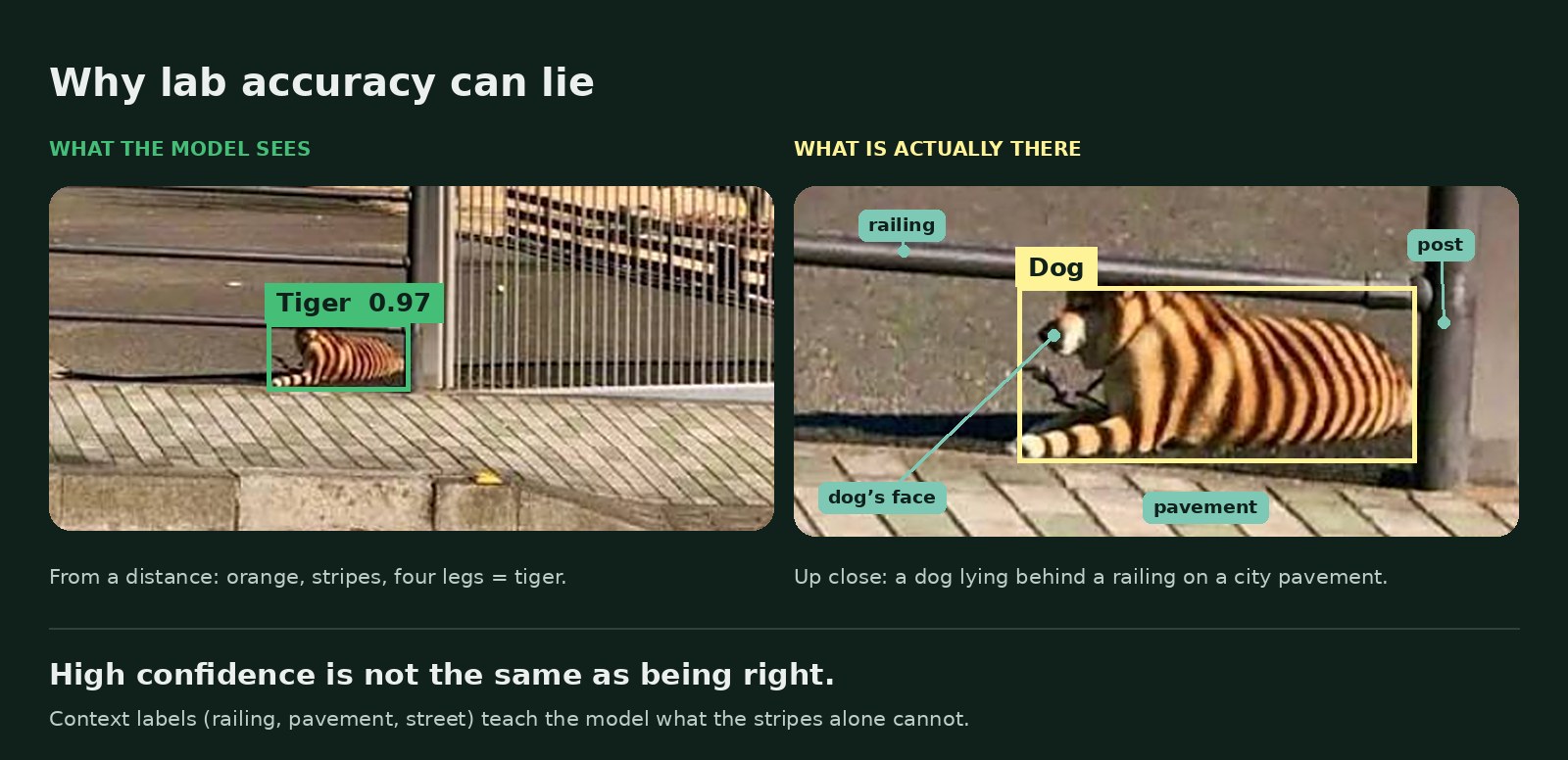
This is more than a glitch; it’s a symptom of three systemic production killers.
1. The distribution shift trap
Models often fail because the production environment looks nothing like the training environment. When your training data lacks the messy, multi-modal noise of reality, like harsh shadows or industrial debris, the model over-indexes on simple patterns.
2. Overfitting to silence
In the lab, data is quiet. In the real world, data is noisy. If your annotation standards were inconsistent or lacked a managed QA layer during labeling, your model learned to recognize a “tiger” in a vacuum rather than a “dog” in a complex scene.
3. The edge case bottleneck
Most AI failures happen at the edges: the rare scenarios that turn up again and again in production. Without continuous validation pipelines, you aren’t just missing these cases; you’re scaling your failures.
Moving from prototype to production
Scaling AI safely requires moving past vanity metrics and toward data certainty. This means:
- Gold-standard dataset creation: ensuring your ground truth accounts for environmental context.
- Continuous data QA: a feedback loop that identifies “tiger test” failures as they happen.
- Dedicated data ops: embedded teams that catch the nuances automated benchmarks miss.
The Orboroi standard
At Orboroi, we help computer vision and applied AI companies bridge the gap between “lab accurate” and “production reliable”. We provide the high-quality datasets and rigorous validation frameworks needed to ensure your model doesn’t just see patterns, but understands the world.
Don’t let your model fail the real world. Optimize for certainty, not just scores.